

- 8 April 2025
- Posted by: Twissen
- Categories: Overviews, Trends

The Travel & Tourism Development Index 2024 by the World Economic Forum evaluates 117 economies based on factors that promote sustainable, resilient, and inclusive tourism development. The index measures sectors such as infrastructure, environmental sustainability, socioeconomic conditions, health and safety, and air and land connectivity. The report highlights how tourism was severely impacted by the pandemic but underscores the progress made to improve competitiveness, particularly in emerging countries. Future trends point towards greener, more technological, and conscious tourism, with a focus on balancing economic growth and environmental sustainability.
The main challenges remain linked to climate change, inequalities, and the need for more inclusive policies. The report indicates that countries with better management of natural and cultural resources attract more tourists, but it also stresses the need to strengthen resilience to future crises, such as environmental disasters and pandemics. A clear example is China, which ranks first globally for travel motivations but ranks 4th for natural and cultural resources, while placing 49th in health and hygiene. Italy performs better, ranking first for cultural resources and 27th for infrastructure and health security.
Digitalization and innovation are key factors in ensuring the growth of the tourism sector, alongside a particular focus on policies for preserving cultural and natural heritage.
In terms of ICT development and digital services, the top 10 is dominated by Northern European and East Asian countries, with Denmark holding the global lead, followed by South Korea and the Netherlands.
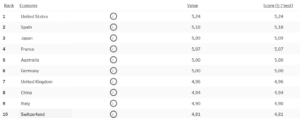
According to the Travel & Tourism Development Index, which combines various economic and tourism factors, the United States leads the global ranking in 2024, ahead of Spain and Japan. However, as shown by the examples, this general order drastically changes when more specific aspects and indices are considered.
At Twissen, we have observed that global tourism is undergoing a transition towards more sustainable models, requiring investments in infrastructure, international collaboration, and innovations in the transportation and services sector.
