

- 20 February 2025
- Posted by: Twissen
- Categories: Destinations, Trends
WeChat and Weibo are two fundamental pillars of China’s digital landscape, playing a crucial role in shaping tourism trends and facilitating interactions between Chinese travelers and international destinations. With over 1.3 billion active users, WeChat serves as a multifunctional platform integrating instant messaging, social media, online payments, and various services, making it indispensable for Chinese citizens. Weibo, often compared to Twitter, is a microblogging platform that enables rapid information sharing and large-scale discussions.
Recent reports from Dragon Trail on WeChat and Weibo analyze the performance of both platforms in 2024 (WeChat e Weibo), providing a detailed overview of Chinese travelers’ preferences and behaviors, as well as Italy’s positioning in this global landscape.
WeChat and Weibo: Strategic Channels for Tourism
Since its launch in 2011, WeChat has remained a cornerstone of tourism marketing for the Chinese audience. The Dragon Trail report highlights that in 2024, destinations that achieved the highest engagement on WeChat were those that successfully combined informative content, special offers, and compelling storytelling.
Weibo, on the other hand, continues to be a key platform for viral communication and user engagement. Data shows that the most successful posts come from tourism boards that effectively leverage popular hashtags, collaborations with influencers, and high-quality visual content.
Chinese Tourism and Emerging Trends
The large-scale return of Chinese tourists traveling abroad is one of the most significant trends of 2024. Destinations that have successfully adapted to evolving traveler expectations—offering digitalized services and targeted marketing campaigns on Chinese social media—have achieved the best results.
Among emerging trends on WeChat and Weibo, DMOs, hotels, and cruise lines have seen a notable increase in market share from 2023 to 2024, reflecting renewed consumer interest. Meanwhile, attractions and museums have maintained steady engagement, with a slight increase mainly driven by Disneyland Hong Kong. In contrast, interest in airlines has dropped significantly, by over 80%.
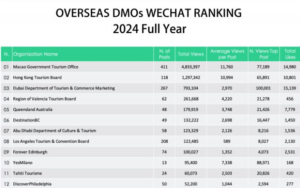

Sources: 2024 Full-Year Weibo Rankings Report, 2024 Full-Year WeChat Rankings Report by Dragon Trail
At the same time, attracting foreign visitors to China remains a challenge. Platforms like WeChat and Weibo are introducing multilingual tools and promotional campaigns aimed at Western markets, but outbound tourism continues to far exceed inbound travel.
Europe in the Landscape of Chinese Tourism
Italy is not among the Top 10 most-mentioned destinations on Chinese social media.
Spain stands out as the leading European destination, ranking 4th among foreign national tourism boards on WeChat, following Japan, Thailand, and Shanghai. This trend is also reflected in the ranking of the most active international DMOs, where Valencia takes 4th place, ahead of Edinburgh and Milan, which rank 9th and 10th, respectively.
On Weibo, meanwhile, Nordic countries such as Norway and Denmark have gained significant traction in 2024, reaching 5th and 6th place in engagement rankings, surpassing France and Germany.
Conclusions
At Twissen, we believe that effectively leveraging platforms like WeChat and Weibo is essential for attracting Chinese tourists and enhancing relationships with international visitors. While Italy maintains strong appeal, refining its digital strategy is crucial to remaining competitive. The adoption of innovative campaigns, a stronger presence on these social media platforms, and better integration of digital services are key to strengthening Italy’s position in the Chinese tourism market and attracting a growing number of visitors from China.
